
The One Prompting Habit
If you've asked ChatGPT or Claude for something and gotten back a bland, generic result, the instinct is usually to type more
The One Prompting Habit That Actually Moves the Needle
If you've asked ChatGPT or Claude for something and gotten back a bland, generic result, the instinct is usually to type more. Add more context, more adjectives, and more "Please make it good." In practice, that rarely fixes anything.
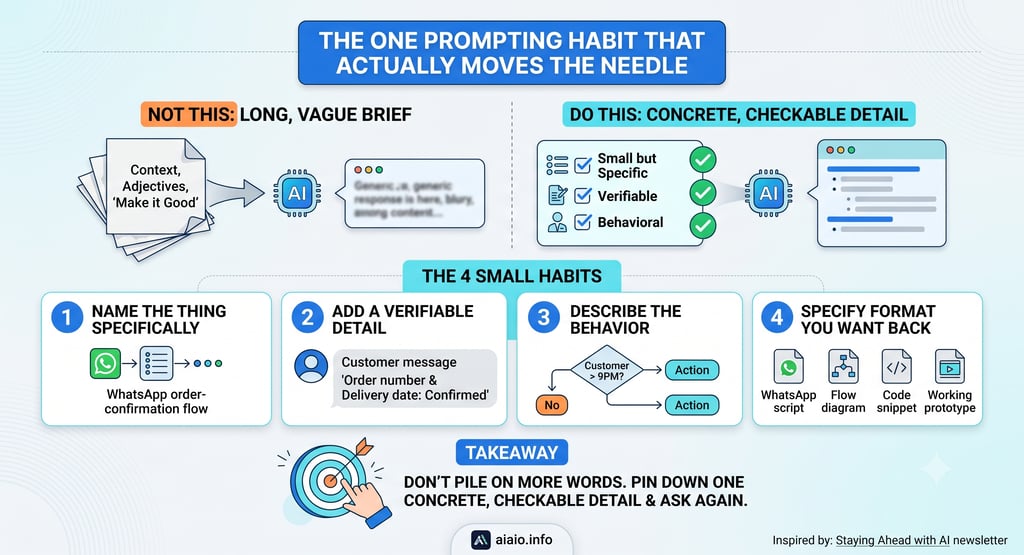
The pattern we keep seeing — with our own clients and echoed in a recent breakdown by the Staying Ahead with AI newsletter — is that detail beats length. The AI builds that go viral for looking impressively "smart" almost always trace back to a request built on a few concrete, checkable specifics rather than a long, vague brief.
What "concrete" actually means
It comes down to four small habits, and none of them involve writing more:
Name the thing specifically. "A WhatsApp order-confirmation flow" beats "some kind of automation."
Add a detail someone could verify. "Confirms the order number and delivery date" is checkable. "Make it professional" is not.
Describe the behavior, not just the look. If something should update, notify, or branch based on a condition, say so explicitly—otherwise you tend to get something static that looks right and does nothing.
Say what format you want back. A WhatsApp script? A flow diagram? A working prototype? Naming it upfront saves a round of back-and-forth.
Why this matters for your business
When we scope automation for a client—a WhatsApp bot, a lead-response system, or an internal process tool—the businesses that get the sharpest first draft aren't the ones with the longest requirement documents. They're the ones who can point to one specific, verifiable thing: "When a customer messages after 9pm, the bot should log it and reply with next-day availability."
That's a sentence any AI (or human developer) can be held to. "Make the bot smart and helpful" isn't.
Takeaway: The next time an AI tool—or a vendor, for that matter—gives you something that misses the mark, don't pile on more words. Pin down one concrete, checkable detail and ask again.