What "Owning Your AI Model" Actually Means for a Business
There's been a lot of noise lately about "open" AI models — the idea that you don't have to rent intelligence from a cloud provider, you can run a model on your own machine instead.
What "Owning Your AI Model" Actually Means for a Business
There's been a lot of noise lately about "open" AI models—the idea that you don't have to rent intelligence from a cloud provider; you can run a model on your own machine instead. A recent piece from Staying Ahead with AI made the point in the simplest way possible: they just installed one and used it.
Worth unpacking, because the distinction matters more for Indian SMEs than it sounds.
Open-weight vs. open source—the difference that matters
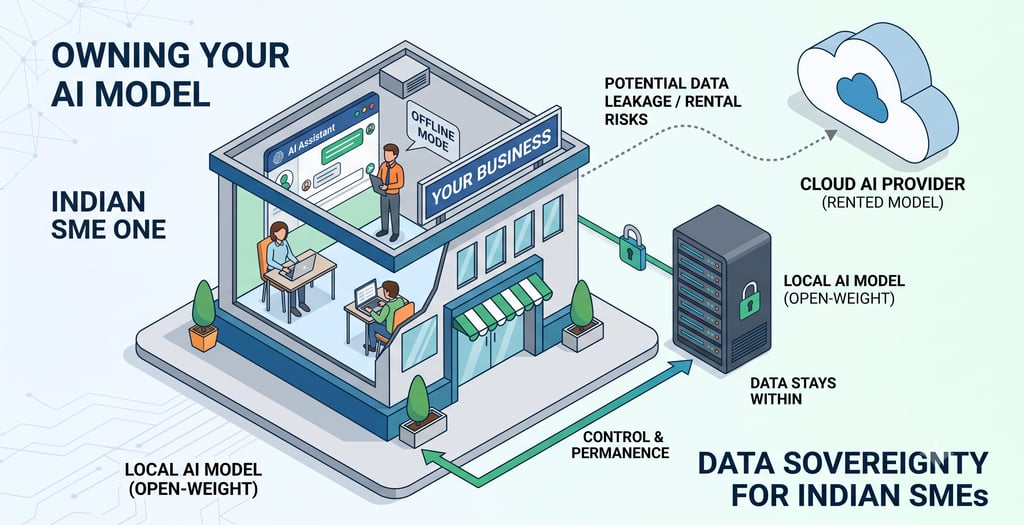
Most models marketed as "open" today are open-weight: you get the finished, trained model as a downloadable file. You can run it, fine-tune it, and nobody can revoke your access to it later. What you don't get is the training data or the method used to build it — that's the "open-source" part, and almost nobody actually hands that over.
Practically, open-weight is still a real shift. It means:
The model runs on your own hardware, with no internet connection required after setup.
Nothing you type goes to an outside server — relevant if you're pasting customer data, financials, or anything sensitive into a chatbot today.
Nobody can pull access later. Cloud-hosted models can (and have) become unavailable overnight due to policy or licensing changes outside your control.
Where this fits for an SME:
For most day-to-day business writing and drafting, a small open-weight model running locally is plenty. It won't outperform the Frontier Cloud models on your hardest problems, but for internal notes, first-draft replies, or anything where you'd otherwise be pasting sensitive information into a public chatbot, it's a genuinely useful free option to have available.
The bigger picture: As more businesses handle sensitive data through AI tools, understanding where your data actually goes—and having an offline fallback for the sensitive stuff—is worth five minutes of setup.
Takeaway: you don't need to rebuild your stack around this. But knowing the option exists and what "open" actually buys you is useful the next time a vendor pitches you an AI tool on the strength of that word.